AI-accelerated development
Large language models to speed up writing, review, documentation, testing and refactoring, with human validation throughout.
Code · Tests · Review · DocsAI holds a real place in how PI-GROUPE delivers, along two distinct lines: accelerating software design, and orchestrating business processes through agents. Here is how — and, more importantly, within which limits.
Large language models to speed up writing, review, documentation, testing and refactoring, with human validation throughout.
Code · Tests · Review · DocsScenario exploration, architecture decision records, documentation and constraint analysis with AI assistants.
Architecture · ADR · IaC · SecurityAutomated collection, transformation, classification, generation and hand-off towards enterprise systems.
Agents · RAG · APIs · WorkflowAssisted programming changes how you approach an architecture problem. Where teams once settled for the first workable answer for lack of time, they can now weigh three.
Before settling an architecture, generate and compare several variants with their cost, operational and security implications. The decision stays human, but it rests on a wider field.
Terraform modules, Ansible roles, Helm charts, Go operators. Everything generated goes through review and testing: the model proposes, the engineer validates.
Generating Bats, Molecule, pytest or Helm unittest scenarios. This is the best gain-to-risk ratio of the lot: a generated test that fails shows up immediately.
Documentation written during development rather than six months later. Design documents, runbooks, decision records.
What AI does not do. It does not decide an architecture, does not know your regulatory constraints and carries no responsibility for the outcome. Generated code passes the same quality gates as hand-written code: review, tests, static analysis, vulnerability scan.
An agent is a language model given tools, a memory and a scope. Orchestrated properly, it absorbs the repetitive work that otherwise ties up scarce skills.
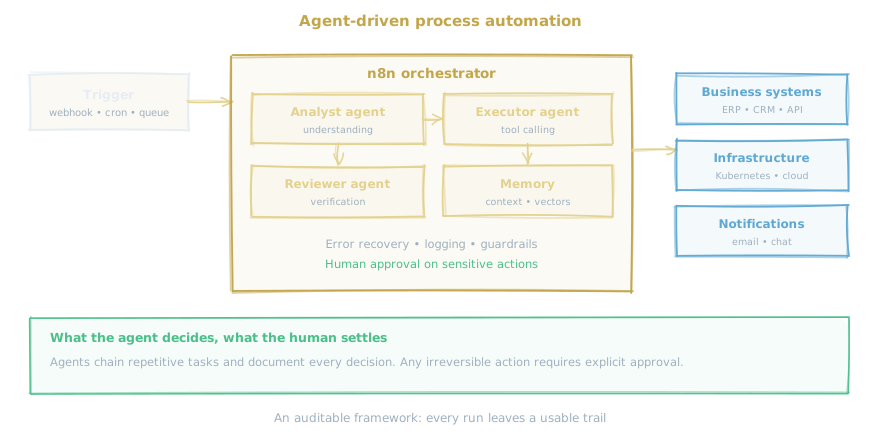
Alert triage and enrichment, first-line incident analysis, post-incident write-ups, change request preparation.
Document flow processing, structured extraction, synchronisation between systems that do not talk to each other, conditional follow-ups and notifications.
Targeted technology watch, tender analysis, preparing design documents from an existing documented estate.
Deletion, payment, outbound sending, production change: the agent prepares, the human approves. The boundary is set during framing, not improvised later.
Input, reasoning, tools called, output, decision. An automated process you cannot audit is one you cannot fix.
Model choice and hosting follow the data classification. For constrained environments, self-hosted models and network segmentation.
Dedicated service accounts, least privilege, call quotas. The same principles as for any other component of an information system.
The first job is telling apart what benefits from automation and what should stay human. That is often the most valuable part of the engagement.