Architecture design
High-level and detailed design documents: logical architecture, technology choices, sizing, network, VPN, peering, DNS, NTP, log collection, monitoring, backup.
Engagements run from architecture framing to production rollout, under one rule: deliver a system your team can operate and evolve without me.
A serious technical design document saves months of rework. It settles the network, the sizing, the backup strategy, the disaster recovery plan and the compliance requirements before the first line of code.
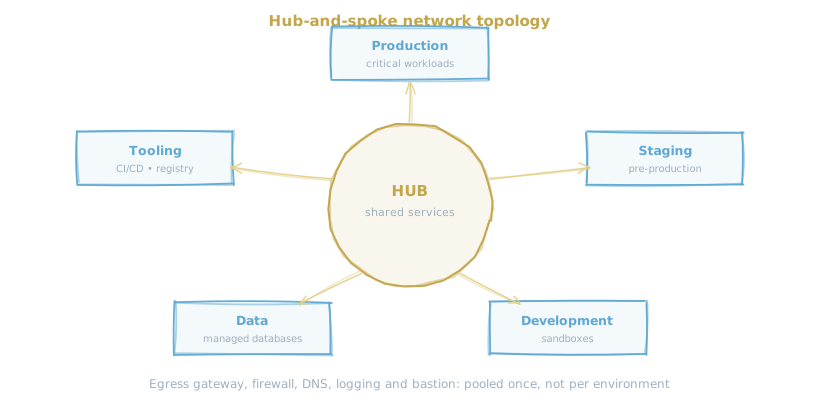
High-level and detailed design documents: logical architecture, technology choices, sizing, network, VPN, peering, DNS, NTP, log collection, monitoring, backup.
Architectures meeting French ANSSI requirements, SecNumCloud qualification studies, government private cloud, secure remote administration and network segmentation.
Migration paths, disaster recovery plans that are designed and actually tested, gradual cutover rather than big-bang.
The question is never whether you need Kubernetes, but how many clusters and how to partition them. A well-designed shared cluster costs less and runs better than ten dedicated ones.
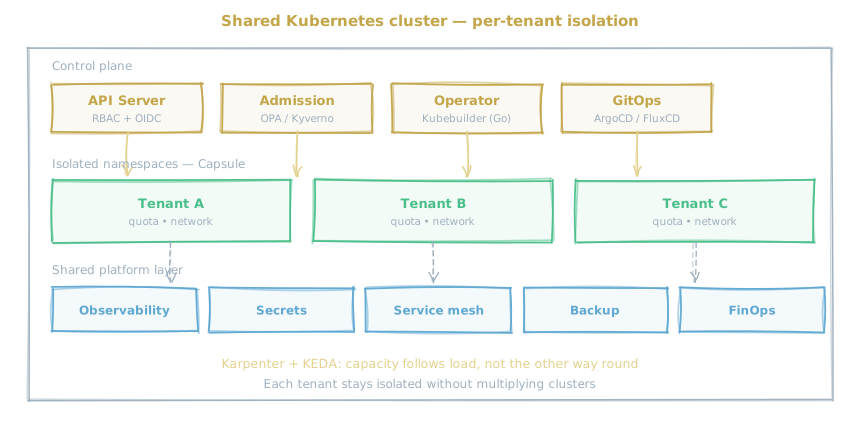
Automated provisioning across the full lifecycle: creation, deletion, node pools, address ranges, service accounts. Driven by API and by workflows.
Isolation through Capsule and hierarchical namespaces, quotas, network policies, permission management per profile — read, develop, operate.
Operators written in Go with Kubebuilder or in Ansible with the Operator Framework, to encode your business rules inside the cluster itself.
Vertical and horizontal autoscaling, smart eviction, spot instances. Capacity tracks actual demand.
A solution architect turns a business intent into a system that holds — and documents why one option won over another.
High-level and detailed design, reasoned technology choices, sizing, costing, pre-sales support.
Domain decomposition, CQRS, event-driven architecture, circuit breaker, blue-green and canary rollout, domain-driven design.
API-first approach, gateways, OAuth2 authentication, role-based access control, tracing, metrics, data strategy.
High-traffic architectures, load balancing, session affinity, server-side caching, load testing.
Review of the existing estate, technical debt identification, a costed and prioritised path out of it.
UML analysis and modelling, OpenAPI 3, ISTQB and ISO 9126 standards, code quality metrics and coding rules.
Infrastructure as code is a discipline rather than a tool: the Git repository becomes the single source of truth, and production stops being edited by hand.
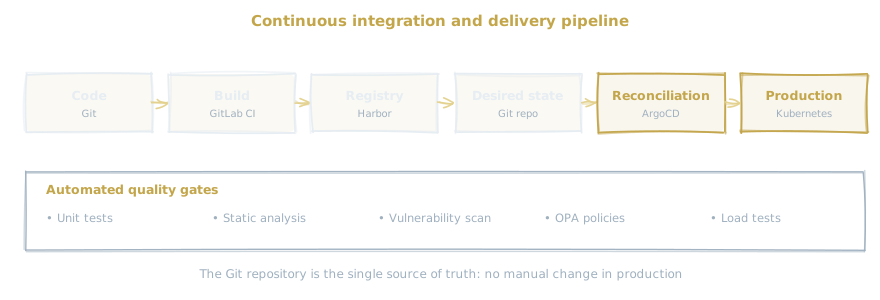
Terraform modules, Ansible roles and playbooks validated with Molecule, images built with Packer, declarative management through Crossplane.
Continuous reconciliation through ArgoCD or FluxCD, generic Helm charts, environment promotion by merge request.
Prometheus, Grafana, Alertmanager, exporters written from scratch when nothing off the shelf fits. Dashboards and alert rules come documented.
Two concrete, proven uses: accelerating design and development, and orchestrating business processes through supervised agents.
Daily pair programming with Claude Code. The gain lies less in typing speed than in the ability to explore several architectural options, generate the tests and keep documentation current.
n8n workflows orchestrating specialised agents — analysis, execution, review — wired into business systems and infrastructure, with full traceability and human approval on sensitive actions.
Describe it in a few lines. I will tell you within 48 hours whether I can help — and if not, who can.