Long engagement
Three to twenty-four months, time and materials or fixed price, on site or remote. The usual format for a full industrialisation programme.
No proprietary methodology, no in-house vocabulary. A simple progression, proven across some twenty engagements, whose end goal is your autonomy.
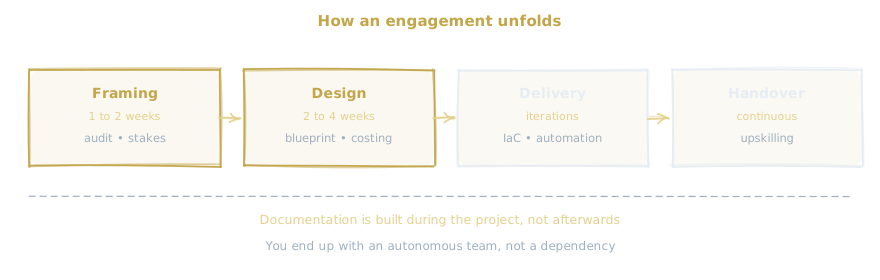
Understand the existing estate before proposing anything: review of the infrastructure, of automation and observability practices, interviews with the teams. The deliverable is a note setting out the diagnosis, the stakes and the options — including doing nothing.
Technical design document, high level then detailed, costing, delivery roadmap. Every choice is argued against the alternatives that were set aside, so it can be revisited later with full knowledge of the trade-offs.
Infrastructure code, automation, tests, gradual production rollout. Each iteration ships something usable. Documentation is written as you go, never retrofitted.
Upskilling the teams, shared code reviews, training. At Thales, at the police prefecture, at the Ministry of Defence, handover was explicitly in scope.
Three to twenty-four months, time and materials or fixed price, on site or remote. The usual format for a full industrialisation programme.
A few days to a few weeks: audit, design document, comparative study, second opinion on a structural decision.
Kubernetes, DevOps, containerisation or microservices sessions, built on your own context rather than on generic examples.
A word on independence. PI-GROUPE works as a supplier, keeping control of its organisation, methods and tooling. That autonomy is not a posture: it is what makes an outside perspective possible rather than reinforcing existing habits.
Yes, with on-site presence for design workshops, steering committees and handover phases. The rhythm follows the project, not a fixed rule.
Yes. The track record includes several programmes in French-speaking Africa, among them the Gabon Digital 2025 plan and a European project run between Paris and Dakar.
Both are possible: directly with the end client, or through a services firm when the context calls for it.
Your team owns the code, the documentation and the skills. Occasional support remains available, but the aim is for it to become unnecessary.
Half an hour is usually enough to know whether the approach makes sense.